How Waterloo Rocketry got their record-breaking rocket to new heights
| September 24, 2026
On Aug. 20, in Timmins, Ontario, the Waterloo Rocketry student design team launched Polaris to a height, or apogee, of 63,497 feet, roughly equivalent to the height of 473 Dana Porter Libraries. Polaris broke the world record for the highest launch of an amateur liquid rocket, an apogee previously set by Georgia Tech’s Vespula at 56,590 feet in May.
Founded in 2012 as a continuation of a fourth-year engineering capstone project, Waterloo Rocketry now consists of over 100 students working out of a bay in the Sedra Student Design Centre on the first floor of Engineering 5. The team, made up of undergraduate and graduate students in and outside of engineering, develops rockets to launch at the annual Launch Canada event.
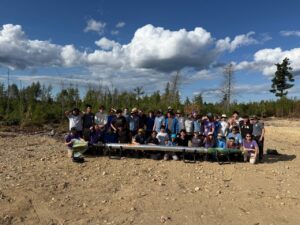
The Waterloo Rocketry team with Polaris. (Photo credit: Andrew Yang)
“I think the chances that we beat the current record right now is like 110 per cent,” team co-lead Jeremy Schnellhardt told Imprint in December 2025. At the time, the record was 47,732 feet, held by Embry Riddle University’s Deneb-1 rocket. Waterloo Rocketry had been developing its liquid engine since 2023 for the rocket Borealis. Design improvements, including to the rocket’s size and fuel capacity, over the three years since Borealis gave the team reason to believe they could break the record.
Although the launch outside of Timmins received the media attention, breaking the world record was not the biggest goal for the members of Waterloo Rocketry. “That’s just a minor goal,” said Matthew Gordon, a senior member of the team and recent mechanical engineering graduate. “Our big goal with Polaris is to get it back in one piece.”
The launch might get the glory, but recovery is a key part of a successful rocket. The second part of the flight brings the rocket safely to the ground. When done successfully, this phase completes a nominal flight. ”We’ve never had a successful recovery at competition,” said Mia Louie, a third-year math and business student and the team’s recovery co-lead. The recovery parachute of the team’s 2025 rocket Aurora failed in competition and resulted in the rocket’s loss, despite successful tests earlier that year. Both Deneb-1 and Vespula were also not successfully recovered.
Louie described how the team improved the recovery system in Polaris to handle seven times the force they expect the rocket to experience. “It’s probably a bit overkill, but it’s good to be safe,” Louie said.
After testing the rocket’s components multiple times throughout the year, Waterloo Rocketry completed the design and manufacturing of Polaris, its largest rocket to date, which stands at 213 inches tall and eight inches wide. On Aug. 13, with equipment in tow, 40 team members made the eight-hour drive from Waterloo to Timmins.
The Launch Canada competition takes place every year in Timmins and brings together teams from all over Canada. There are several categories of rockets that are launched during the week, including solid fuel, liquid fuel, and multistage rockets. The weeklong event begins with a weekend conference, followed by a five day window for teams to launch their rockets. The week culminates with an awards banquet.
Waterloo’s week was plagued with many unforeseen issues that meant the launch did not take place until Thursday. To make the best use of the daylight available, the team starts its day before dawn. A one-and-a-half-hour drive to the launch site means days usually start at approximately 4:30 a.m. The team went into Day 1 of the launch week confident that they would be able to get the rocket in the air that day. Unfortunately, that optimism was short-lived, as issues arose with the brand new antennas used for remote launching and monitoring. The team was forced to abandon the launch on the first day to avoid both communication disconnects and losing their limited supplies of ethanol fuel and nitrous oxide.
The next day was hampered not by technical problems, but by nature. Heavy cloud cover and rain forced all teams to cancel launches scheduled for that day. Waterloo Rocketry took this opportunity to continue fine-tuning the rocket and its launch procedures.
On Day 3, the team once again reached the launch pad at the crack of dawn to prepare for another attempt. The problematic antennas had been swapped for their older but reliable backups and all was ready for the 11 a.m. launch window. Pre-launch processes all went according to plan, telemetry looked normal, and with high anticipation all around, everything felt ready for launch. Three, two, one, ignition… a cloud of nitrous gas surrounded the rocket and everyone awaited the moment the rocket left the launch pad. But after a few beats, the rocket remained grounded. Despite all data reading normal, the rocket had failed to launch. The lack of an obvious failure, other than the rocket still sitting on the launch pad, confused and frustrated the team.
Other teams continued to launch their rockets as Waterloo Rocketry speculated about what might have gone wrong. Finally, with the all-clear given by launch control, the team was able to go to the launch pad. The team found the culprit to be another novel issue: a tube used for fueling failed after being melted by hot smoke. “It’s not for lack of trying, bad design or anything; it’s just like, a thing that happened because we’re trying to launch the rocket,” explained Keegan Tripp, a senior member of the team. The confusion among the team turned to reserved optimism as it became clear that this failure was out of the team’s control — all team members had executed operations correctly, and with the tube requiring only a quick fix, the team still had the resources to launch in the remaining two days.
Waterloo Rocketry arrived at the launch pad on Thursday, ready to finally see the rocket in the air. Just before noon the countdown started again for Polaris: three, two, one, ignition… and this time, it launched straight as an arrow. Though later than they had planned and hoped, the team was ecstatic to see the rocket leave the ground. At apogee, Polaris deployed its initial drogue parachute to slow down the rocket as it fell. Seven minutes after liftoff, the parachute deployment was confirmed.
“Everything was going our way, everything was nominal, it was unreal.” Schnellhardt said of the launch. “Finally hearing that we were under main parachute… It felt like a weight lifted off my shoulders,” Louie said in a statement to Imprint. The launch marked Waterloo Rocketry’s first successful recovery in competition, and an experience of “pure vindication for all the sacrifices everybody had made for the rocket and for this team.”
Waterloo Rocketry made the headlines by breaking the world record for the highest launch of an amateur liquid rocket. But perhaps more importantly to them and the future of their program, they also completed their first ever nominal flight in competition and the first ever nominal flight of a liquid rocket in Canada. Reflecting back, Schnellhardt stated that there was ”nothing more we could have asked for out of the flight of that rocket; it was incredible.”
As for what’s next, Schnellhardt told Imprint that the team has ideas but needs to discuss them further as a group to decide what new challenges to tackle with their next rocket.