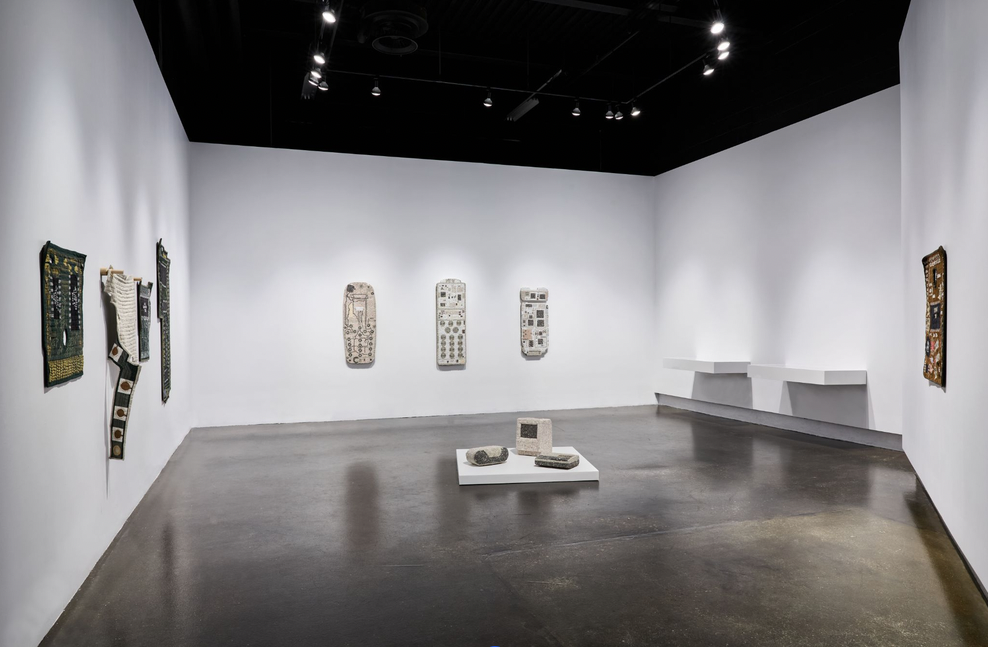
What happens when the nostalgia of obsolete electronics inspires an artist? More than 20 years ago, multidisciplinary artist Laura Moore began exploring the answer as a stone carver. Since then, she has produced numerous pieces of artwork inspired by technology. Her work is currently featured in the Handheld exhibition at UW’s Art Gallery (UWAG) from Sept. 10 to Dec. 5.
Stone carving, quilting, mold-making, and mosaic assemblage are the four creative methods behind Handheld’s featured pieces, which she and Ivan Jurakic, curator and director of UWAG, selected.
Every stone carving in the exhibition is a 1:1 replica of vintage Nintendo devices, all of which were passed down to Moore by family and friends. “I make everything by hand; the process is time-consuming and intensive. Stone carving (the reductive process) is really the only process that comes naturally to me,” Moore said.
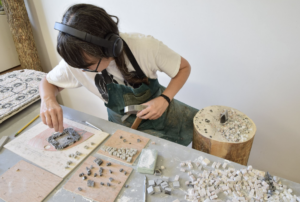
Artist Laura Moore works on her craft. (Photo credit: Paul Cimoroni)
Moore began stone carving in 2001 at the Nova Scotia College of Art and Design University with professor John Greer and later earned a master of fine arts in sculpture in 2006 from York University. She continued sculpting for the next 20 years. During the COVID-19 pandemic, her interest in creating art with other materials developed. “I began quilting… [to work] with second-hand clothing to expand my material process, align with my commitment to sustainability, and to minimize the impact of artwork production,” she noted.
Moore seeks to “provoke conversations about memory and our relationship to the environment” by using “quilt-making techniques to upscale and transform fast-fashion into objects.” Her Memory Quilts feature “textile assemblages” inspired by the interiors of electronic devices she collects and uses.
Her connection to repurposing electronic objects began in childhood. Her father, she says, is a technophile and her mother enjoyed thrifting. Moore also often received hand-me-down devices from her father including her first phones. “Often these objects are tied to my experiences; they’ve travelled with me, entertained me and recorded my memories. I feel connected to them, so when they stop working I have a hard time letting them go,” Moore shared.
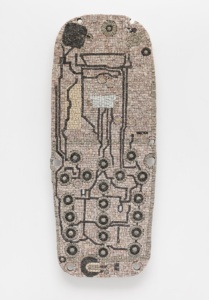
KCF2885, 2025, salvaged marble floor tiles, plywood and cement, 19” x 46.5” x 1.5”. (Photo credit: LF Documentation)
Part of her longtime interest in how humanity intersects with obsolete technology comes from wanting to prevent such items from entering landfills. This is why Moore sourced second-hand marble floor tiles from Facebook Marketplace and thrift stores to create a “suite of mosaics that transform cell phone circuit boards into up-scaled tablets,” titled We Were Here in the exhibition.
One challenge Moore faces in her line of work is the physical strain of constructing her art, specifically the process of cutting the tiles for her mosaics. “Balancing work and rest is my biggest challenge, and I’m still figuring that out.” She now works at a slower pace and heeds the advice of loved ones who support her taking breaks. Still, she says she feels the most comfortable spending lots of time in the studio working on her craft and future projects.
Moore says that it’s a pleasure to have her exhibition run alongside Abraham Oghobase’s exhibition, Notes to Self: Offerings on History and Memory. She thanks Jurakic for inviting her to showcase her art. Moore also expresses gratitude to her family for supporting her practice, and to everyone who visits the exhibit.