

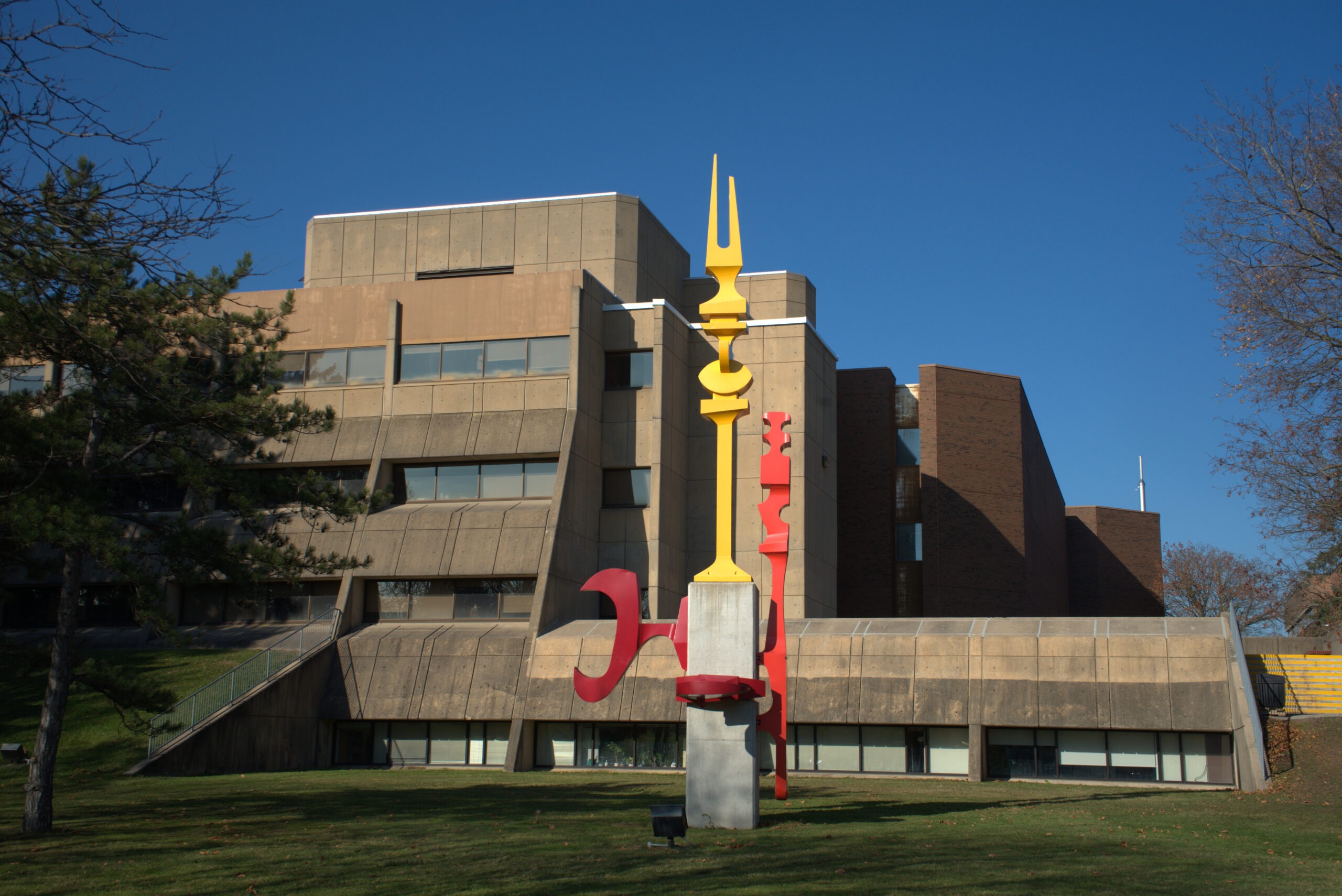
The Psychology, Anthropology, and Sociology (PAS) building. (Photo credit: Ashita Saxena)
According to Academic Ranking of World Universities (ARWU), UW’s psychology department ranks among the top five in Canada, and within the top 100 globally. This distinction was earned through ARWU’s rigorous research-focused criteria which include the presence of highly cited researchers, publications in Nature and Science, and per-capita academic performance.
What makes UW’s psychology department exceptional?
According to Professor Katherine White, Associate Chair of Undergraduate Affairs and a researcher at the Lab for Infant Development and Language, UW has maintained its international reputation because of its “commitment to research excellence and providing a really rich educational environment for students.”
UW’s psychology department has a strong history of research excellence across six broad domains: clinical, cognitive, cognitive neuroscience, developmental, industrial-organization, and social psychology. “We really see research as a fundamental part of our culture in this department,” says White, emphasizing the collaboration and collegiality among faculty and labs that sustain this success. “We all want each other to succeed, we all want our faculty members to succeed and our student trainees to succeed.”
With over 50 years of research excellence, UW’s psychology department has attracted multiple faculty members and researchers who are leaders across these areas, contributing to some of the most groundbreaking and relevant psychological discoveries worldwide. For instance, research from the Self-Attitudes Lab in 2014, led by Professor Allison Kelly, was recognized by Psych Central, one of the largest and most influential mental health platforms globally, as one of the year’s greatest psychological discoveries by demonstrating that approach motivation is a predictor of a person’s sense of meaning in life.
Advanced research facilities and strong funding support
To make the research possible, the department is supported by specialized facilities across key psychology buildings, including the Psychology, Anthropology, and Sociology (PAS) building where several cognitive and neuroscience labs are housed. These sites contain advanced technology such as functional magnetic resonance imaging (fMRI) which allows cognitive neuroscience psychology researchers to measure oxygen concentrations in various parts of the brain, helping to quantify brain activity during resting and aroused states. In addition to fMRI, virtual systems, eye-tracking equipment, and EEG machines are among the advanced technology that researchers can access to fulfill their research requirements.
Waterloo’s strong research history in psychology would not have been possible without continuous funding from organizations like the Natural Sciences and Engineering Research Council (NSERC), the Social Sciences and Humanities Research Council (SSHRC), and the Canadian Institutes of Health Research (CIHR).
White notes that “faculty members are very well funded through a variety of national, international grants, and we have a very strong funding record at the graduate student level.”
Ana Carvalho, psychology program manager, adds, “Funding is a very key element, and our professors also top up this funding whenever it’s possible.”
A student-centred approach to learning
Beyond research excellence, the department is deeply committed to fostering student growth. “Providing a really rich educational environment for students” is central to their mission, says White. Students are encouraged to explore their interests by taking core psychology courses, which expose them to different fields and career paths. “This is how students can figure out what they like, what they don’t like, and what they would like to pursue in their career,” Carvalho states. For instance, students interested in research can enroll in research apprenticeship courses, where they can gain research experience and earn course credit by volunteering in a psychology lab for 96 hours.
Additionally, the co-op program at UW allows psychology students to alternate between academic and work terms in roles related to their field. “For students who would like to graduate and start working immediately, they could join the co-op program and get great work experience,” Carvalho says.
In addition to all of these, the department offers minors such as cognitive science, for those interested in the study of the mind, and human resources management, which provides a certificate that qualifies graduates to work in human resources after graduation.
Busra Subasi, a second-year psychology student at UW, shares positive remarks about the program and the support she felt throughout her time here: “What surprised me the most is how supported I felt here. The professors really want you to explore different paths, and there is space to try things, make mistakes, and figure out what fits. It really feels like the department is invested in you as a whole person, not just as a student.”
Research spotlight: The Danckert Lab
Within the field of cognitive neuroscience, researchers at UW focus on understanding neural mechanisms that underlie basic cognitive functions like perception, attention, and decision-making. In addition to understanding neural mechanisms, researchers aim to understand the relationship between these cognitive functions and factors such as brain injury, age, and individual differences, among many others.
James Danckert, professor of cognitive neuroscience, leads the Danckert Lab, which focuses on the mechanistic changes in the brain that lead to boredom.
Many think of boredom as a state of apathy and start conjuring an image of a “couch potato” in their heads, Danckert explains. However, boredom could also be thought of as a state of high arousal, the itching feeling of doing something — in other words, being restless. Thinking of these higher cognitive functions as complicated states urges researchers to understand the neural mechanisms that lead to boredom.
Danckert explains that boredom is controlled by a network of brain areas called the default mode network. “This is a network of brain areas that is active when you don’t have anything to do,” he states. In addition to activating the default mode network, Danckert mentions that boredom “activates parts of the brain that are important for representing how you feel… like your amygdala, which is important for emotional regulation.” The activation of these other parts of the brain then induce negative feelings like agitation that we feel when we are bored.
He emphasizes that boredom is not a passive state. “The key thing about boredom is that it’s a motivational state… When you’re bored, you care, and you care because you want to be doing something, but you can’t figure out what that should be.”
While in the process of conducting cognitive neuroscience research, Danckert values the collaboration and the people within the psychology department at UW that make this research possible. “The physical structure of what’s here is probably replicated across most departments of psychology across the world. So it’s not the stuff, it’s the people, and I think it’s a very open environment,” he said.
He mentions that much of his research benefited from the collaboration opportunities offered among researchers at Waterloo. “I have collaborated with an evolutionary biologist where we did some genetic work… I have [also] collaborated with a philosopher, and so collaboration is key to any science.”
Having had students volunteer at his lab and complete their thesis for their degree, Professor Danckert recommends that students just reach out to different labs and ask if they have got any opportunities, whether that be for volunteering or paid research apprenticeships. However, he cautions for students to cultivate their experiences and not approach opportunities randomly. “If you get two months of experience in five labs, that might not be as good as five months experience in two labs. You need enough time to understand the process in a lab and for the lab to get to know you.”
Danckert recommends students start to volunteer in second year. “If you volunteer in one lab per year for your second, third, and fourth year, then I think that would give you a breadth of experience that would be really helpful.”
Overall, what sets UW’s psychology department apart is not only its global research reputation, but its belief that discovery and education must move forward together through collaboration, collegiality, and a shared commitment to fostering a rich and supportive educational environment.